
Melnikov House
Dream all you want

In the late 1920s in Moscow, only a few people were allowed to build private houses. There was a push for collective housing and permits to build single-family homes became scarce. Amid the turmoil and uncertainty, architect Konstantin Melnikov was able to build a home and workshop for his family. The house—a mystical, idyllic masterpiece—is one of the most important surviving architectural landmarks of the Russian avant-garde.
In the first decade of the Soviet Union, Melnikov was one of the most famous working architects. He built around 20 structures, among them six workers’ clubs in Moscow, the Bakhmetevsky garage, the Makhorka pavilion for the All-Russian Agricultural Exhibition, and the pavilion of the USSR at the International Exhibition of Decorative and Industrial Arts in Paris. The latter catapulted him to the global stage, where his startling work was celebrated as an example of the rousing innovation possible in the USSR. In 1924, he was even rewarded with the hallowed task of designing Lenin’s glass sarcophagus to be put on view in Red Square. But no good coffin goes unpunished. In thirteen years’ time, Melnikov would be excommunicated from the field of architecture, never to build again.
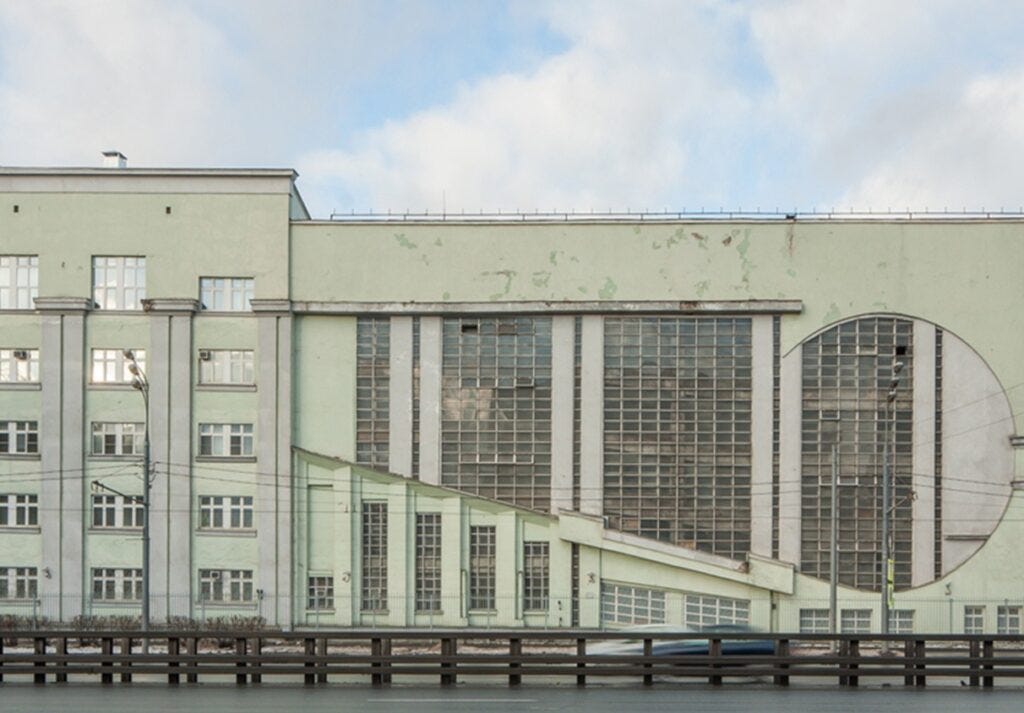
The Intourist Garage (1934). Credit: Denis Esakov.
Melnikov’s crime was simply that he had failed to advance the ideological project of the USSR in his buildings. Fool! In 1937, at the First All-Union Congress of Soviet Architects, he was publicly denounced as a “formalist” who was concerned too much with his own fanciful ideals and not enough with the Stalinist demands of the discipline. Stalin preferred staid classicism to the modernism produced by the avant-garde, which he felt was too alien and incomprehensible for the peasantry. For him, the project of socialism required forms that could be readily embraced by the masses. Melnikov was nominally associated with the Constructivists, an architecture movement produced by the avant-garde which was shut down by Stalin wholesale. Melnikov had stood a bit apart from the group due to the romantic subtleties of his sensibility and his nonconformist temperament. Sadly, that did not spare him. He attempted to abide by Stalin’s demands, incorporating overt Socialist idioms into his work, but the efforts were futile. And so, he spent the rest of his life humbly painting, drawing, and writing inside his special house alongside his family.
In 1918, private property had been largely banned in the USSR, but under the New Economic Policy, instituted in 1921 to alleviate economic pressures that created housing shortages, there was limited approval for the construction of single-family homes. However, by the late 20s, this policy was winding down, and Soviet authorities were again beginning to emphasize collective housing.
Still, Melnikov was able to get permission to build his masterpiece for a few reasons. He received the plot of land as a reward for designing Lenin’s sarcophagus (many have done far worse for less). He’d also made a good amount of money as an architect, which gave him the power and financing needed to proceed with construction. But, naturally, he still needed to claim that his “private” interests interlocked with the interests of the state. So Melnikov sold officials on the idea that the house was an experimental model for communal housing. I thought this case sounded a little thin due to how beautiful and seemingly complex the house is, but it’s actually true, as Melnikov argued, that the house was economical to build compared to traditional building methods, mostly due to its use of innovative open-work brick masonry techniques. His design cut brick consumption in half relative to the requirements of conventional masonry. It also decreased stress distribution, removing the necessity of load-bearing pillars or lintels over entryways. Bricks were being rationed during this time, so these innovations were critical.
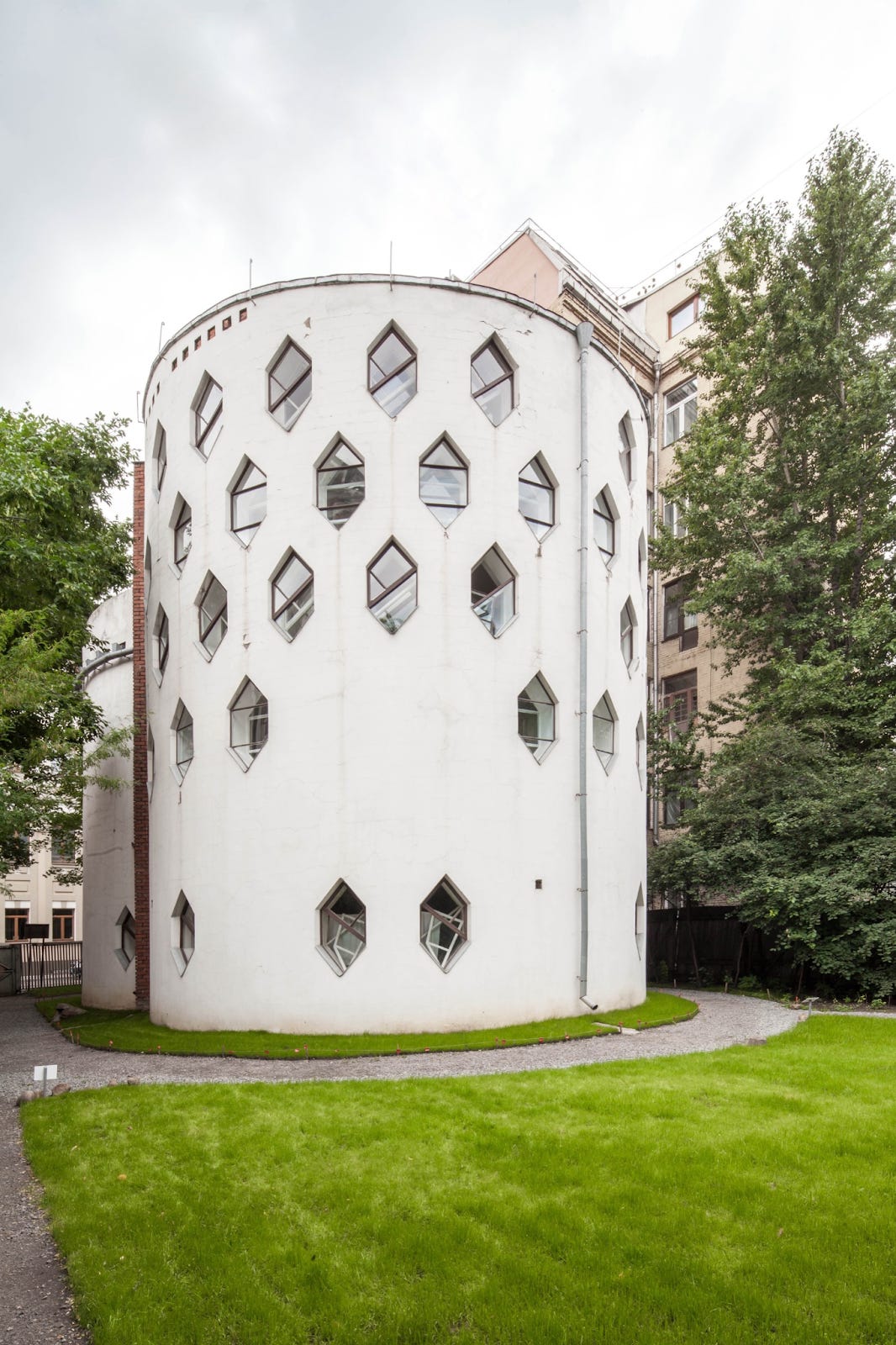
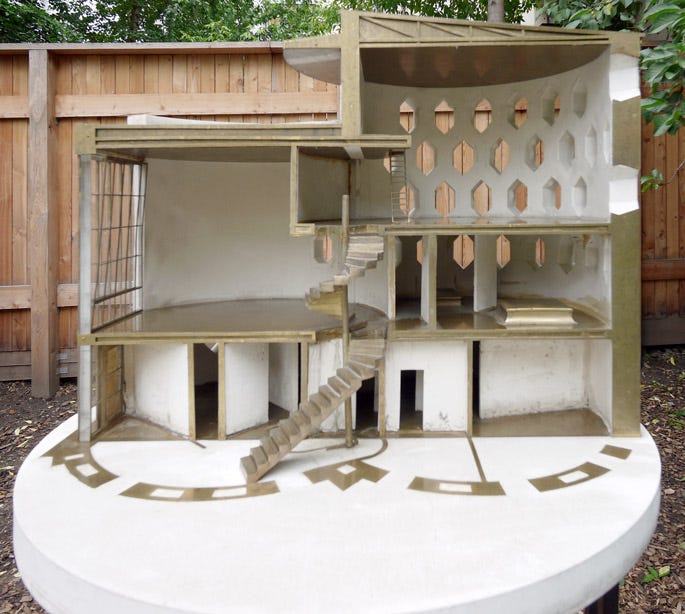
Melnikov’s sources of inspiration are not entirely clear, but among them, according to a profile of the architect in Granta from 1973, were the cylindrical structures of the utopian projects by Boullée and Ledoux and grain silos in the American Midwest. The house is made up of two concentric cylinders, overlapping to create the figure of a number eight. It’s filled with light from end to end, with an array of honeycomb-like windows wrapping around the back and a wall of paned glass at the front. There are three floors connected by a spiral staircase slithering up the center chamber of the house.
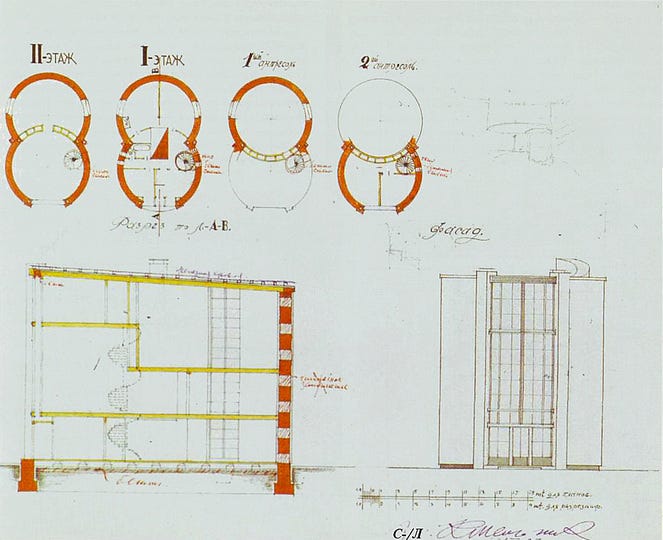
The interior of the house is coated in the hopeful tones of spring: lavender, pale pink, seafoam, and yellow. Melnikov used color theory developed by the painter, composer, and theorist Mikhail Matyushin to select the paint colors. Matyushin was concerned with the harmonization of color and form: he identified preferred associations between shapes and colors. All across the house, there’s evidence of delicate balancing. Melnikov said that the essence of the house lies in the “equivalence and equability of weight, light, air and heat”.
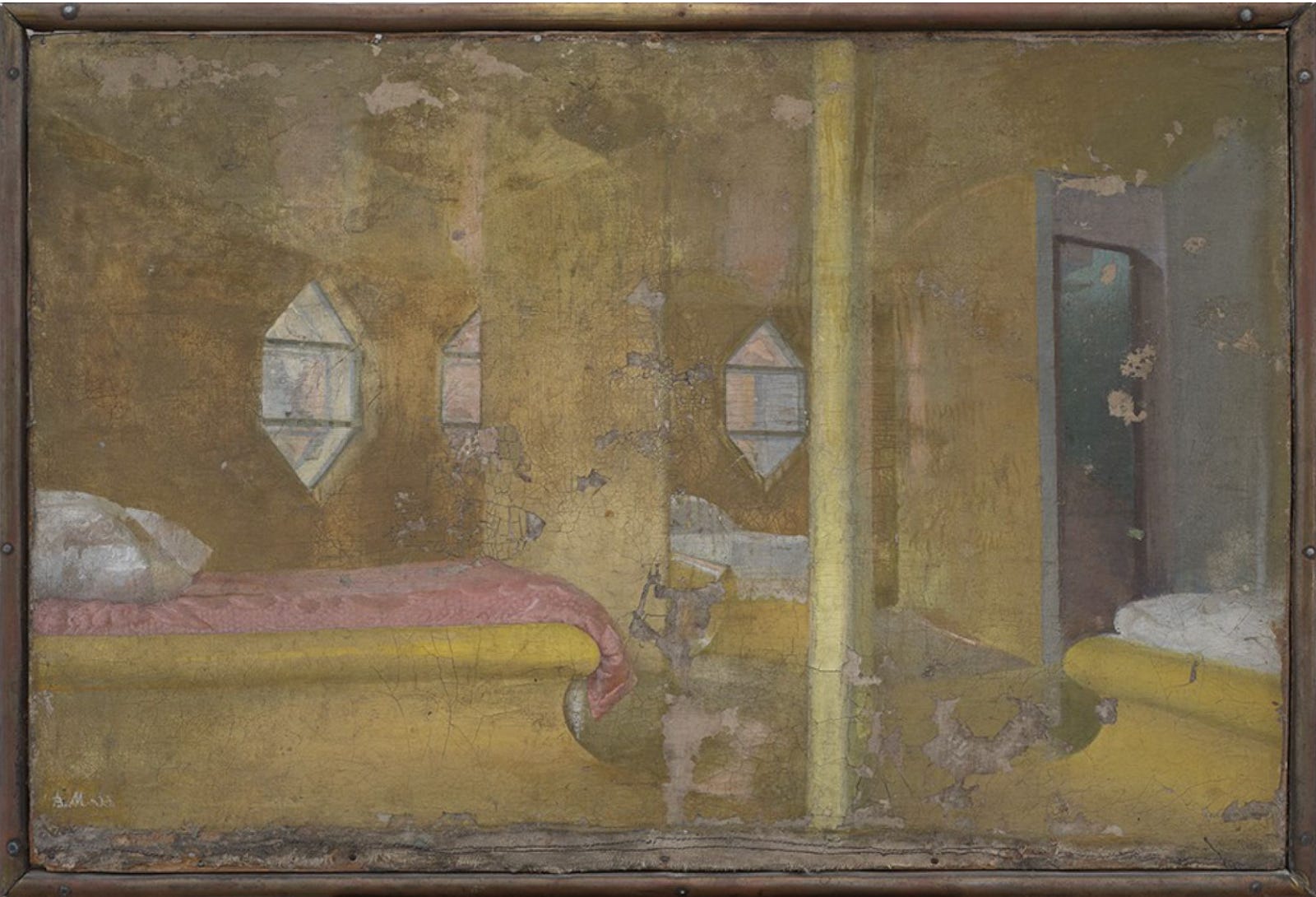
Despite the high-concept framework informing the shape of the house, the materials were plain: wood, plaster, brick. The house contains both the humble and the holy. On the second floor, the bedroom walls, ceiling, and beds were covered with a copper-gold metallic paint, resembling the gold leaf used in icon paintings. This was lost during the post-war renovation but can still be seen in the painting below by Melnikov’s son Viktor. Melnikov had mystical beliefs about sleep and its relationship to immortality, inspired by the ideas of the father of Russian Cosmism, Nikolai Fyodorov. In Melnikov: Solo Architect in a Mass Society by Frederick Starr, Melnikov was quoted as saying, “[we spend] twenty years of lying down without consciousness, without guidance as one journeys into the sphere of mysterious worlds to touch the unexplored depths of the sources of curative sacraments, and perhaps of miracles. Yes, everything is possible, even miracles.”
According to Starr, Melnikov had drawn up designs for something called Green City outside Moscow. It was to be a place of respite for exhausted workers, featuring a sleeping pavilion with capacity for several hundreds of people. It was named the Sonata of Sleep. Starr writes,
At either end of the long buildings were to be situated control booths, where technicians would command instruments to regulate the temperature, humidity, and air pressure, as well as to waft salubrious scents and “rarefied condensed air” through the halls. Nor would sound be left unorganized. Specialists working “according to scientific facts” would transmit from the control centre a range of sounds gauged to intensify the process of slumber. The rustle of leaves, the cooing of nightingales, or the soft murmur of waves would instantly relax the most overwrought veteran of the metropolis. Should these fail, the mechanized beds would then begin gently to rock until consciousness was lost.
Sadly, this project was never realized.
During World War II, a German bomb hit nearby and blew out all the windows. Exposed to the elements, the gold paint eroded, never to be replaced.
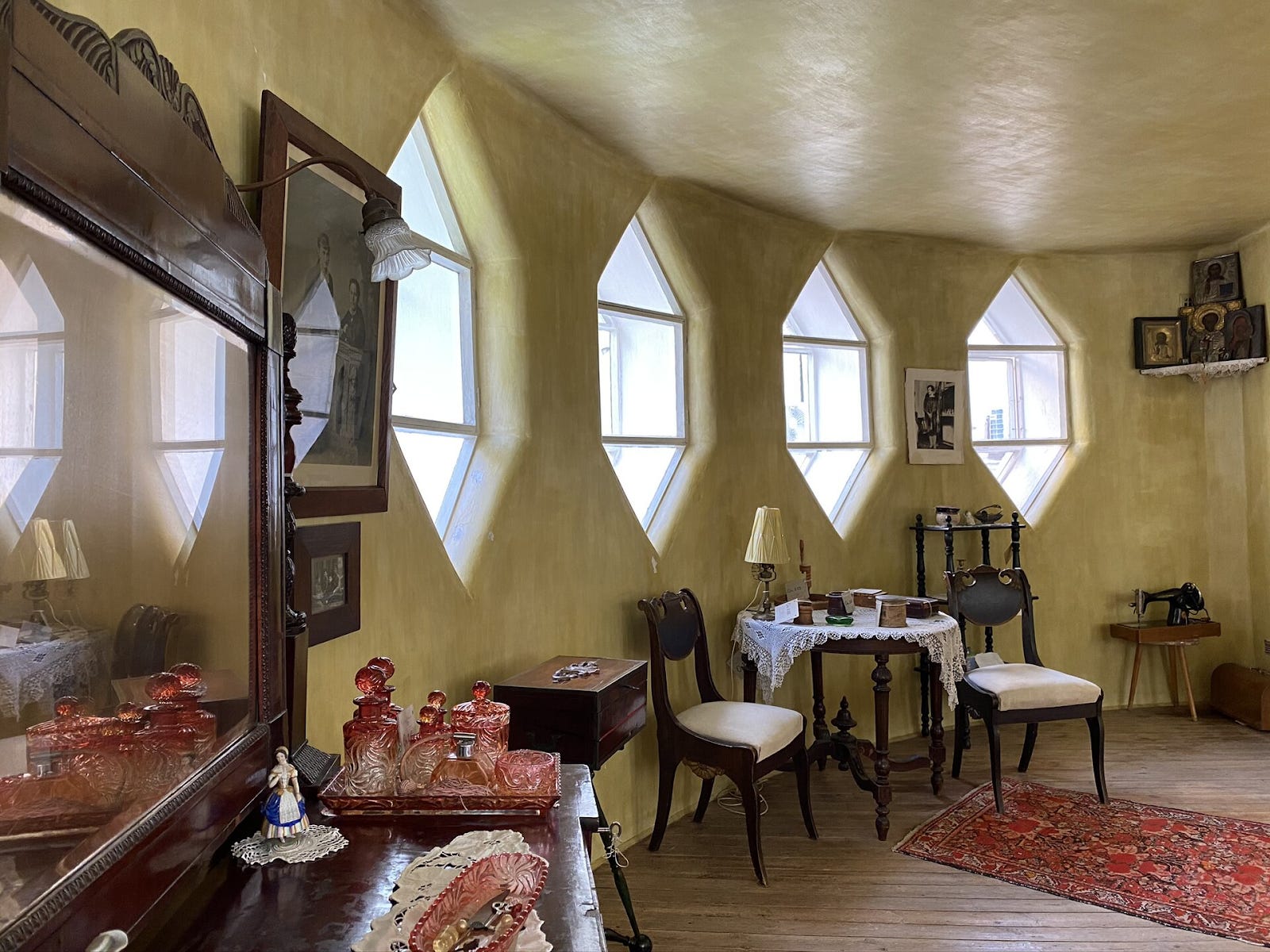
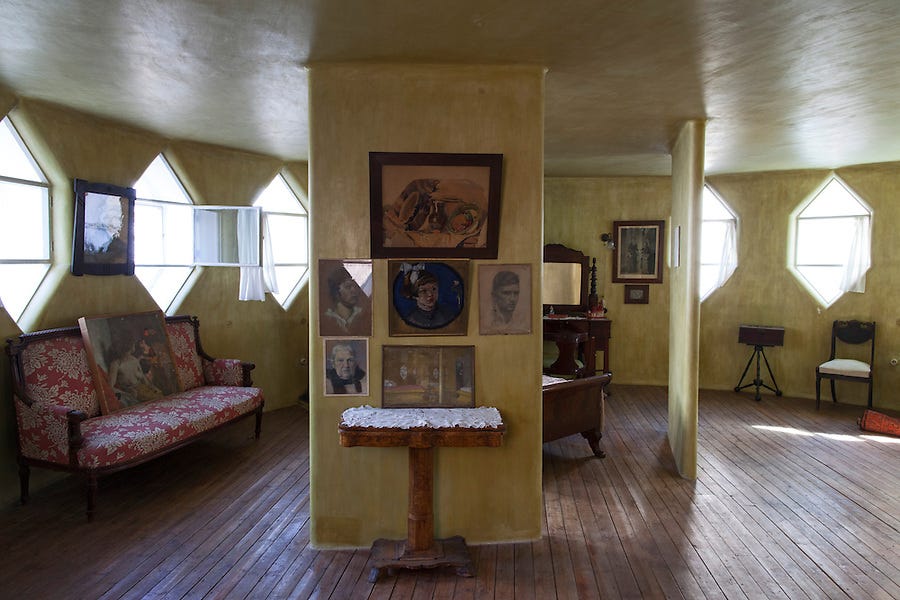
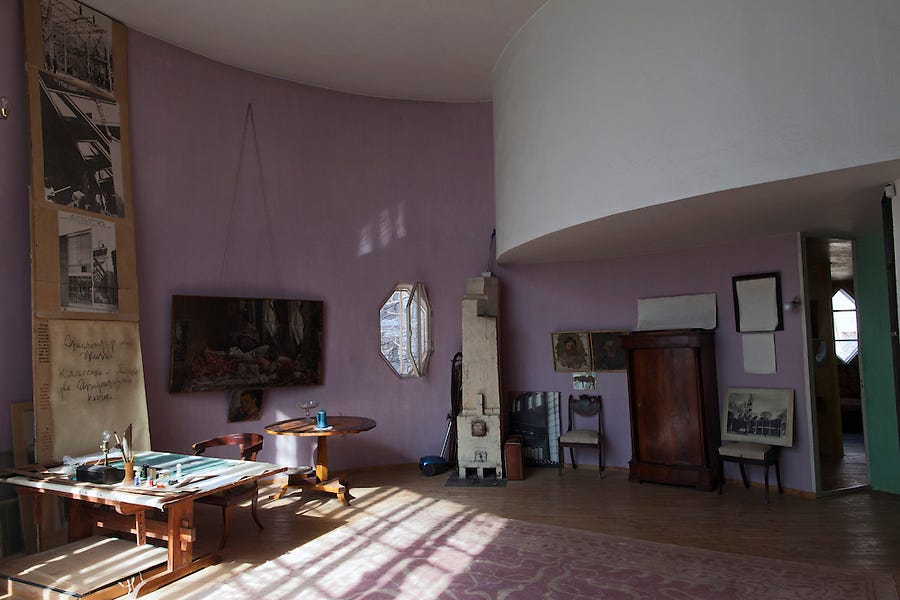
On the third floor is the drawing room and Melnikov’s workshop. The drawing room faces the front of the house, with floor-to-celing windows that open out onto a terrace. The workshop faces the backyard. Its most notable feature is an array of 38 rhomboid windows curving around the room, which were meant to prevent the creation of shadows when Melnikov drew—further evidence of his fanaticism for control over every aspect of sensory experience. The height of the ceilings and the light pouring in make one feel capacious and airy, ideal sensations in an environment meant for creation. Among the charming details of the house, there is a speaking tube that connected the workshop to the street so that Melnikov could receive notice of visitors without needing to descend. Other aspects of the house, such as the lack of ornament and simplified forms, are standard-fare modernism contrasting with the mismatched bourgeois neoclassical furniture that currently fills the house. Much of it was put there by his wife, Anna Yablokova, who did not completely share his radical tastes. Her choices aren’t for purists, but I sort of appreciate the contrast.
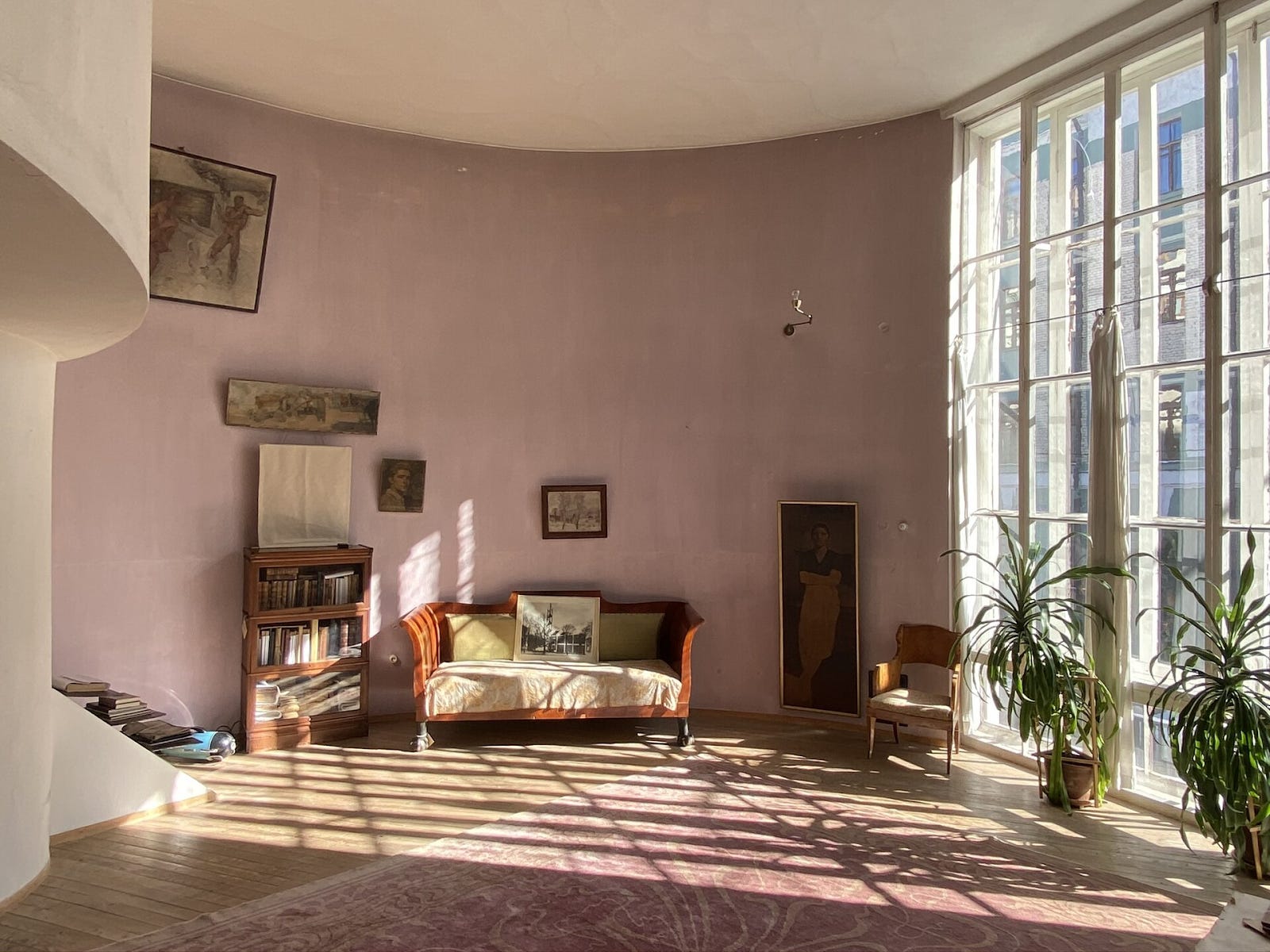
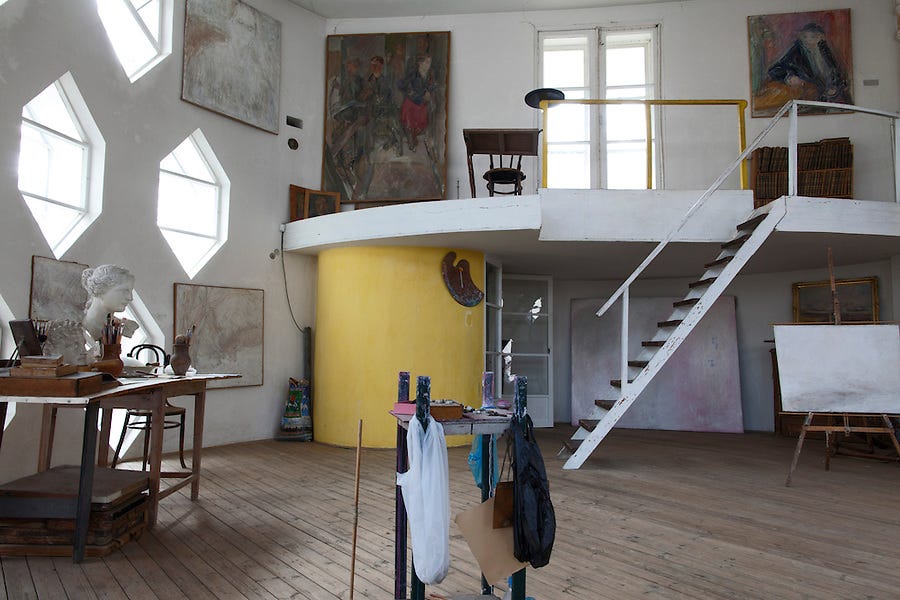
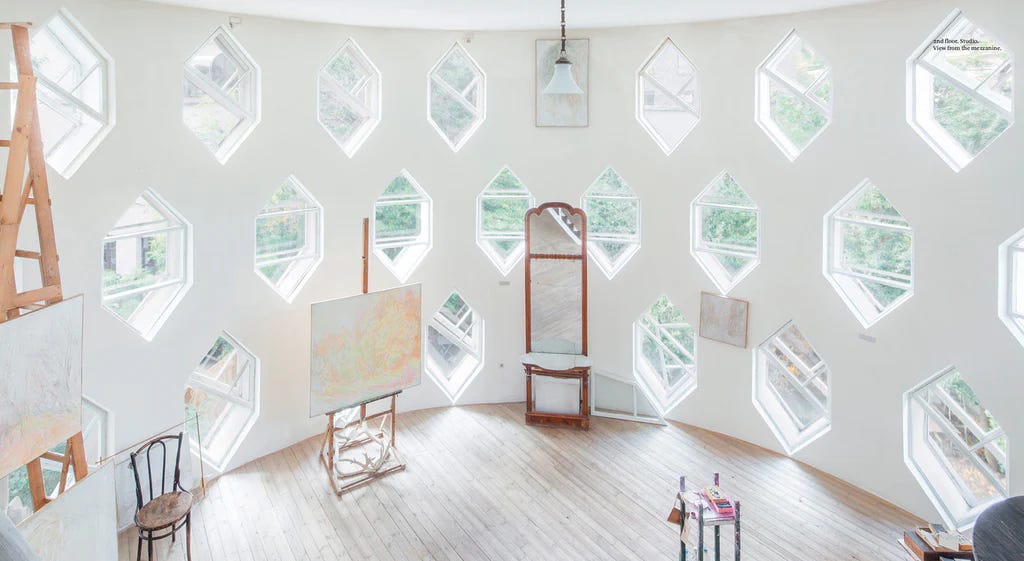
As with many state-of-the-art modernist buildings, the Melnikov House still feels surprising and fresh even to contemporary audiences. There’s a future there that is crumbling, still waiting for its chance to be born. Melnikov’s friend and fellow Constructivist architect, Ilia Golosov, said upon returning to the house many years later, “The windows might be infilled, the balconies long since disappeared⎯what all this damage proves is that buildings with this much power and conviction can still carry you away with them… I look at this and I can still feel radiating off the bloody thing, the promise of a better society.”
This was very cool. Thank you. I'd never heard of this architect.